
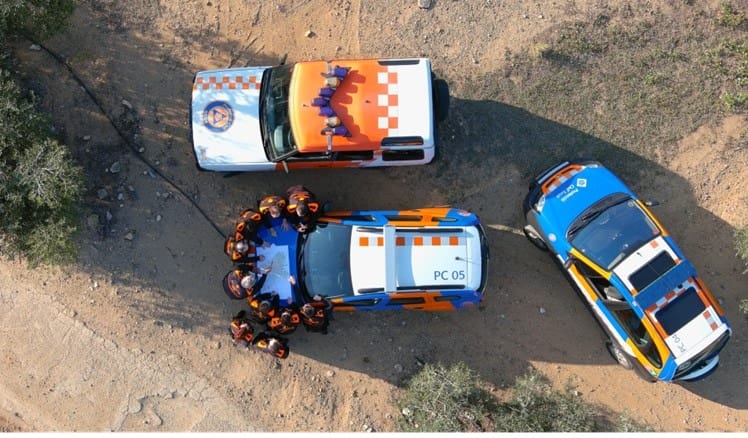
High Line Division Unmanned Systems recently traveled to the city of Reus to provide specialized training on the use of drones in the field of security and emergencies. This training was directed at members of the Reus Civil Defense Volunteers Association (AVPCR), a group committed to public safety and emergency management in the region. This training event reflects the growing interest in using advanced technologies, such as drones, to improve responses to critical and emergency situations, where time and precision are key factors.
The collaboration between High Line Division and AVPCR not only highlights the importance of continuous training in emerging technologies but also stands as a testament to both organizations’ commitment to staying at the forefront of emergency management. Additionally, this training event held special significance as it coincided with the celebration of the 20th anniversary of the association. To commemorate this significant occasion, various multimedia productions were carried out, capturing footage with both handheld cameras and drones in outdoor and indoor settings. These images will be used to create a corporate video that will reflect the history and achievements of AVPCR over its two decades of service.
Training in the use of drones for security and emergencies
The course provided by High Line Division Unmanned Systems was designed to equip AVPCR members with the necessary concepts to assess the use of drones in emergency and security situations. Drones have proven to be invaluable tools in these areas due to their ability to provide a panoramic and detailed view of the terrain, access hard-to-reach areas, and conduct search and rescue operations more efficiently than traditional methods.
During the training, the volunteers learned how to assess the use of drones in a variety of critical situations, such as locating missing persons, evaluating damage after a natural disaster, monitoring forest fires, and controlling crowds at large events. Drones can also be equipped with thermal cameras, enabling operators to detect heat signatures in areas where visibility is limited, such as during fires or night operations. This capability is crucial for search and rescue efforts, allowing trapped or missing individuals to be located more quickly and effectively.
The importance of technology in emergency management
In an increasingly digitalized world, the incorporation of new technologies like drones in the field of security and emergencies has become a priority. Civil protection organizations, such as AVPCR, are rapidly adapting to these advances, recognizing that drones offer a significant competitive advantage in terms of faster response times, reduced risks for personnel, and greater efficiency in decision-making.
Drones enable emergency teams to gain a detailed view of a situation in real time, which is essential for coordinating resources and making informed decisions. For example, in the case of a forest fire, drones can fly over affected areas and provide thermal images that show the spread of the fire, allowing firefighters to act more precisely and efficiently. Similarly, in flood situations, drones can quickly map the affected areas, identify evacuation routes, and help locate trapped individuals.
Multimedia production and celebration of the 20th anniversary of AVPCR
The 20th anniversary of the Reus Civil Protection Volunteers Association was the perfect occasion to highlight the crucial role this organization has played in the safety and well-being of the community over the past two decades. To celebrate this milestone, a series of multimedia productions were carried out, capturing the essence of the work done by the volunteers throughout the years.
The recordings included both aerial and ground shots, captured with drones and handheld cameras in various settings and situations. The use of drones provided stunning images of the Reus surroundings, as well as unique captures of indoor events, offering innovative perspectives that would otherwise be difficult to achieve. These recordings will be edited and used to create a corporate video that commemorates the history and accomplishments of AVPCR, while also serving to promote volunteering and attract new members to the organization.
The corporate video will not only serve as a tool to showcase the association’s work but will also highlight the importance of the collaboration between technology and community service. Throughout its 20-year history, AVPCR has successfully adapted to changes and challenges, incorporating new tools and methods to improve its emergency response capabilities. The inclusion of drones in its technological arsenal is a clear example of this adaptation, as these unmanned aircraft are revolutionizing the way emergencies are managed.
Future prospects for AVPCR and the use of drones
With the training provided by High Line Division Unmanned Systems, AVPCR is well-positioned to continue advancing the use of drones in emergency situations. This technology holds a promising future in the field of civil protection, as its versatility and effectiveness in gathering critical information allow emergency teams to act more quickly and accurately.
As drone technology continues to evolve, it is likely that its use in the realm of security and emergencies will keep growing. With more advanced drones equipped with precise sensors, civil protection organizations will be able to further improve their capacity to respond to critical situations, ultimately leading to higher levels of safety for communities.
In summary, the collaboration between High Line Division Unmanned Systems and AVPCR has not only served to train volunteers in the use of drones for emergency situations but has also allowed the essence of the association’s work to be captured through multimedia productions commemorating its 20 years of service. This event marks an important step toward the future of AVPCR, which continues to innovate and adapt to the demands of a constantly changing world while playing a vital role in protecting and ensuring the safety of the community.
